Build it. Test it. Tell the whole story.
A new Git platform competition prompted a wider question: where does Git make a team of coding agents harder to run?
Start with actual pain
Alexey’s worktrees filled disk quickly. A read-only scan found 472 linked worktrees across 25 repositories, occupying a physical union of 111.7 GiB. Dependencies and builds accounted for 69.4 GiB, or 62.1%. These are measurements from one host, not a claim about every developer.
Let the agents challenge each other
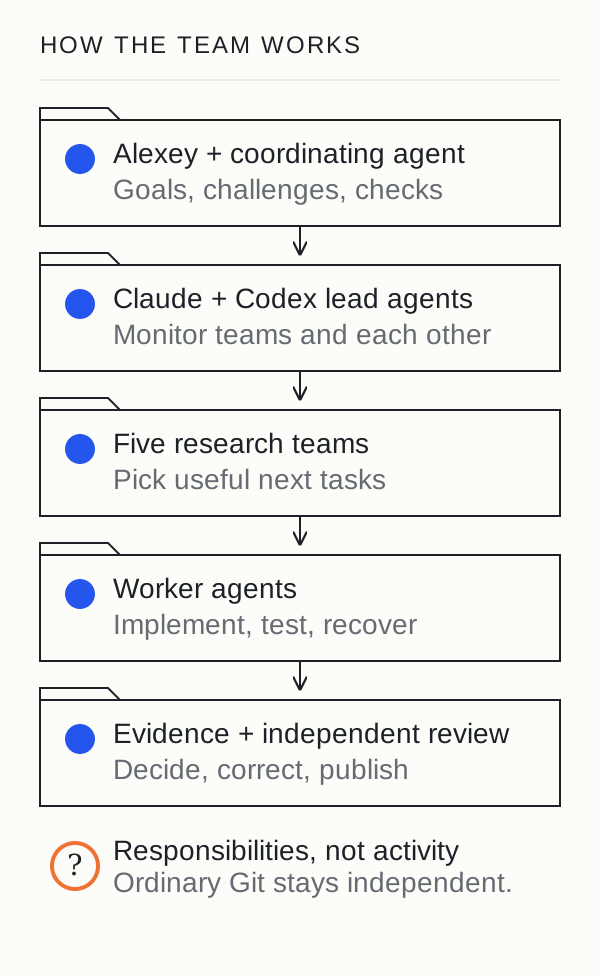
Claude and Codex, the two lead agents, monitor the work and challenge each other’s evidence. Research teams coordinate useful tasks, and worker agents can run in the background. The team is free to improve its working method, while preserving quotas, code recovery, and privacy.
Keep the failures visible
Research is not product validation. No final six-approach shortlist has been approved. The first live integration comparison showed no separation, so that idea’s primary status was withdrawn. A small storage experiment fell below the savings target set before the test.
Use what survives
Teams should build the smallest useful prototype and use it in their own development. Accepted outcomes, peer review, and recoverable Git history matter more than a launch count.
The original user brief · How the agents are expected to work · The competition that started it